Serving Tidewater · Mon–Fri 9:00 – 5:00
Yard & Drainage Guide · Updated September 2026
Short answer: it depends which problem you actually have. Search that phrase and you'll find two completely different products lumped under the same name. Here's the difference, and how we solve both.
The first is an under-deck ceiling system: panels or troughs installed underneath an elevated deck that catch rain and snowmelt falling through the board gaps, routing it to a gutter so the space below stays dry and usable. The second is yard-level drainage: moving standing water away from your deck's footings, your foundation, and the low spots in your yard where it collects after every storm.
We install both, and they solve genuinely different problems, so it's worth knowing which one you actually need before you call anyone. If your issue is a wet, unusable space underneath a second-story deck, that's the under-deck system covered below. If it's water pooling in the yard, near your deck's posts, or against the foundation, that's the ground-level work — French drains, grading, and the rest — that makes up most of this guide.
If your deck is elevated — a second-story deck, or one built well above grade — rain and snowmelt fall straight through the gaps between the boards onto whatever is underneath. An under-deck drainage system closes that gap. Panels or a sloped membrane installed under the joists catch that water before it reaches the ground, and channel it to a gutter run along the deck's perimeter, which carries it to a downspout instead of letting it drip through onto a patio, storage area, or outdoor kitchen below.
The real payoff isn't just staying dry during a rainstorm. It's turning space that's currently unusable half the year into an actual second living area underneath the deck — covered patio, a dry spot for storage, or room for an outdoor kitchen that doesn't need its own roof.
Standing water after every storm isn't just an inconvenience. Left alone, it can undermine a deck's footings over time, erode the surrounding yard, and make an outdoor space unusable for days at a stretch. It's often the real difference between a deck you can walk out onto right after it rains and one you have to wait out.
A French drain works by giving water an easier path to follow than the one it's currently taking through your yard. A perforated pipe, wrapped in gravel and fabric, channels water underground to a spot where it can drain safely away from the house, the deck posts, or whatever low area collects it after every storm. We install French Drain Man's drainage products — perforated pipe, catch basins, and fittings — for this work, rather than building it out of whatever's on the shelf at a big-box store.
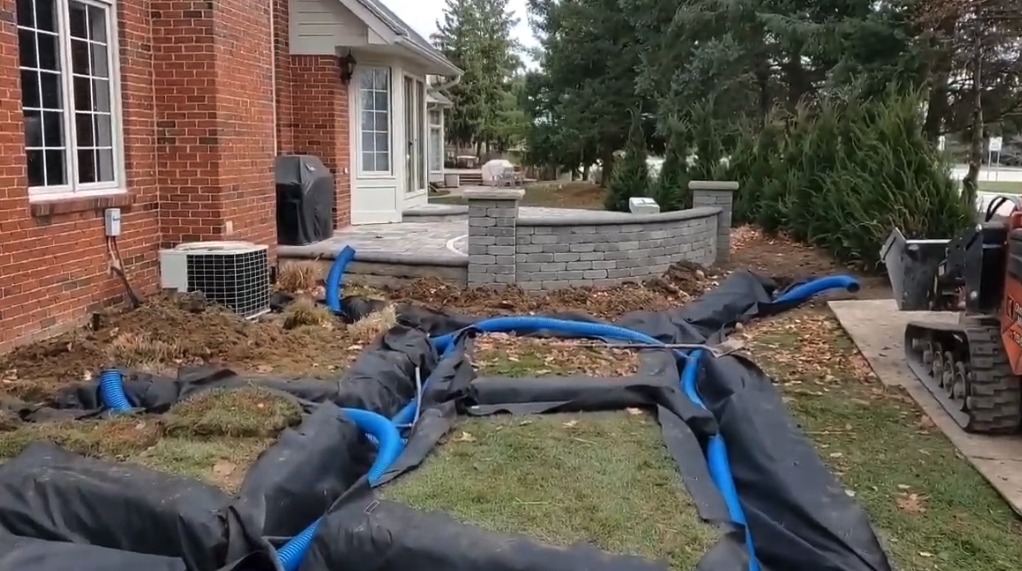
A French drain isn't always the whole answer. We also tie in downspout extensions to move roof runoff further from the house, and address grading issues where the yard itself slopes toward the house instead of away from it — a surprisingly common, easy-to-miss cause of water collecting exactly where you don't want it.
In some cases a sump pump is the right solution for a persistently wet low spot that gravity alone can't drain fast enough. A French drain relies entirely on gravity and slope; if the lowest point in your yard genuinely has nowhere lower to drain to, a sump pump is what actually moves the water out instead of just relocating it a few feet away.
| Fix | What It Solves | Best For |
|---|---|---|
| French drain | Redirects water underground along a gravity-fed path | Water collecting near footings, posts, or low areas with somewhere lower to drain to |
| Downspout extension | Moves roof runoff further from the house | Water pooling right at the foundation after rain |
| Regrading | Corrects a yard sloped toward the house instead of away | Water consistently running the wrong direction |
| Sump pump | Actively pumps water out instead of relying on gravity | A low spot with nowhere lower to gravity-drain to |
Most yards need one or two of these, not all four — the right fix depends on where your property's water actually goes.
Every drainage project starts with actually watching where the water goes during and after a storm, not guessing at it from a dry yard. A drainage plan built from a guess is just moving the problem a few feet over; one built from watching a real storm move through your property routes water somewhere it genuinely won't cause damage. See our full Yard Drainage Systems service →
It depends which problem you mean. An under-deck ceiling system captures water falling through the gaps of an elevated deck to keep the space below dry. A yard drainage system, like a French drain, moves standing water away from your deck's footings, your foundation, and low spots in the yard before it causes damage.
Yes. Alongside our ground-level drainage work — French drains, downspout extensions, grading, and sump pumps — we also install under-deck drainage systems that keep the space underneath an elevated deck dry and usable.
A perforated pipe wrapped in gravel and fabric is buried underground, giving water an easier path to follow than the one it is currently taking through your yard. It channels that water to a spot where it can drain safely away from the house, deck posts, or low areas that collect it after every storm.
Standing water can undermine a deck's footings over time, erode the surrounding yard, and make the space unusable for days after every storm. It is often the difference between an outdoor living space you can use right after it rains and one you have to wait out.
We install French Drain Man's drainage products, including perforated pipe, catch basins, and fittings, for the French drains, downspout tie-ins, and sump discharge lines we build.
Sometimes. Gravity alone cannot always drain a persistently wet, low-lying spot fast enough. In those cases a sump pump is the right solution rather than relying on a gravity-fed French drain that cannot keep up.
Written by Ashleigh & Joey, Evoke Design + Build
Husband-and-wife design-build team serving Hampton Roads since 2017. Ashleigh handles design, Joey runs construction. Licensed & insured contractor. Read more about us →
We'll come watch where the water actually goes and tell you honestly what it needs.