Serving Tidewater · Mon–Fri 9:00 – 5:00
Types Of Fences · Updated September 2026
The five most common backyard fence types are wood, vinyl, aluminum, chain-link and split-rail. Wood runs $15–$50 per linear foot installed depending on style, vinyl $20–$25, and aluminum $11–$55 (HomeAdvisor, 2025). In Hampton Roads' salt air and humidity, vinyl and aluminum need almost no upkeep; wood needs resealing every 2–3 years to hold up.
We're a Hampton Roads design-build team that's built four real, genuinely different fence styles across our recent projects, and it shows up in real client feedback: "Evoke design did beautiful, fast and clean work replacing my old rotting wooden fence and outdoor shower stall." — Dianna Curtis, Google review. The breakdown below is what we actually walk homeowners through on-site.
| Type | Per Linear Ft, Installed | Avg. Total Cost | Maintenance | Typical Lifespan |
|---|---|---|---|---|
| Wood | $15 – $50 | $1,919 – $4,948 | Reseal / stain every 2–3 yrs | 15 – 20 yrs |
| Vinyl | $20 – $25 | $2,000 – $5,000 | Occasional wash, no sealing | 20 – 30+ yrs |
| Aluminum / Metal | $11 – $55 | $2,426 – $6,791 | Minimal, occasional touch-up | 20 – 50 yrs |
| Chain-Link | $8 – $40 | $1,297 – $3,587 | Periodic tie tightening | 15 – 20 yrs (30 w/ coating) |
| Split-Rail | $15 – $35 | $2,500 – $4,000 | Reseal / repaint, rot risk | Varies by material |
Source: HomeAdvisor, fence installation cost overview, HomeAdvisor, wood fence cost data, HomeAdvisor, aluminum/steel fence cost data and HomeAdvisor, chain-link fence cost data (2025).
Wood is still the most common backyard fence, and it comes in three real shapes: privacy (solid boards, no gaps, $25–$50 per linear foot), picket (spaced boards, usually 3–4 ft tall, $20–$40 per linear foot), and shadowbox ($10–$40 per linear foot depending on the wood grade). A shadowbox fence alternates boards on opposite sides of the rail, so each side gets a full board instead of the two sides sharing one flat face. Head-on it reads as solid privacy; from an angle, air and a little light pass through the gaps — which is also why it's sometimes called a "good neighbor" fence, since both sides look identical (HomeAdvisor; Angi).
We built a shadowbox-style privacy fence almost exactly like this around a new pool in Deep Creek, Chesapeake — full pressure-treated wood, wrapping a much longer perimeter than a typical suburban yard because the lot sits open and rural near the Great Dismal Swamp. The gate hardware was sized and installed to meet Virginia's pool-barrier code: self-closing, self-latching, and swinging away from the pool.
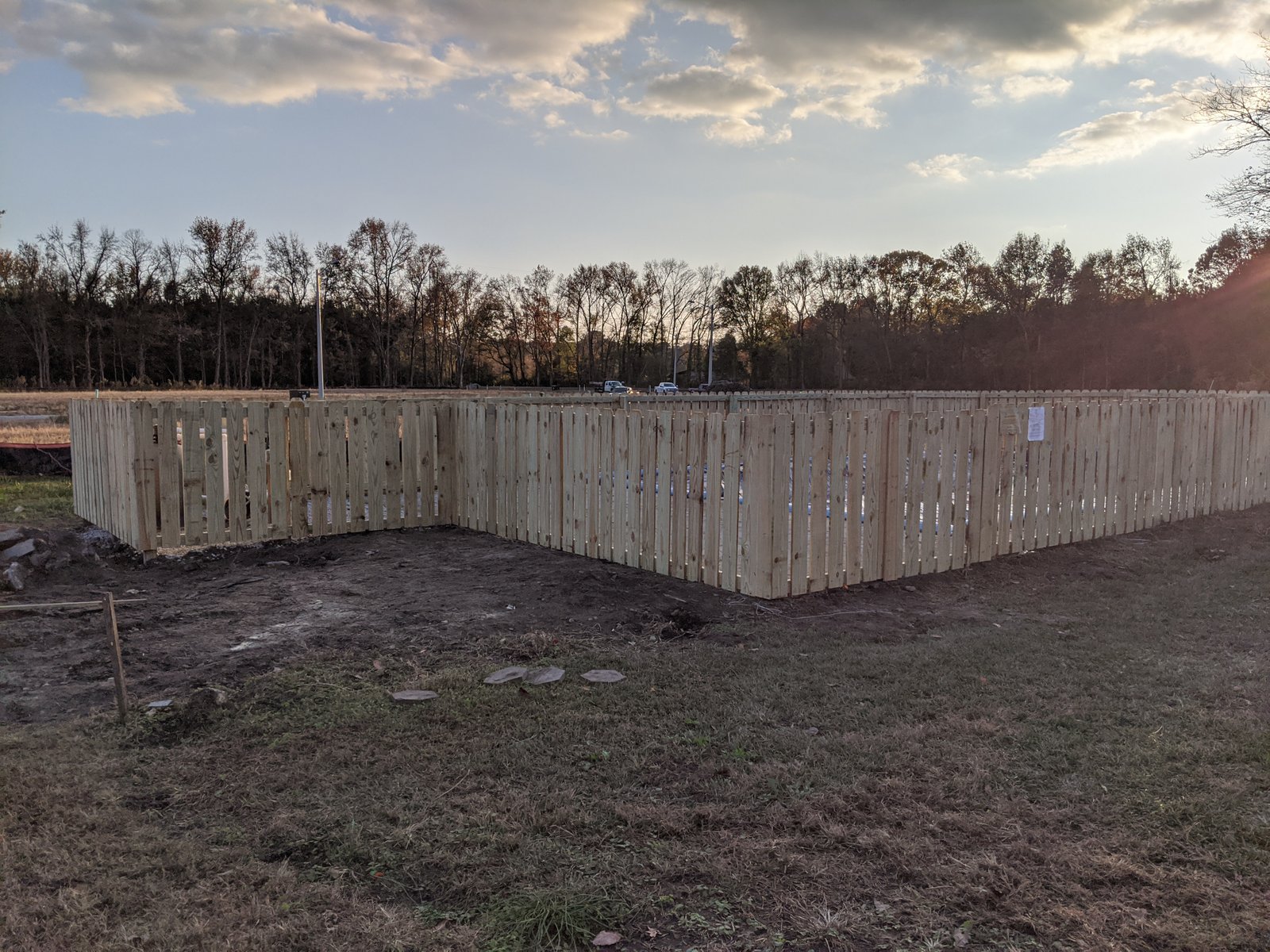
The Gallberry Pool Fence — shadowbox-style pressure-treated wood, built to Virginia's pool-barrier code. See the full project →
Wood's real tradeoff is upkeep, not looks. Cedar carries natural oils that resist decay and insects, which is why it's the wood coastal contractors lean on most in salt air — but it costs more per foot and still needs resealing every 2–3 years. Pressure-treated pine costs less upfront and is what we build with most often, but it needs that same reseal schedule to keep Hampton Roads' humidity from finding its way into the grain (Hurricane Fence, coastal Virginia materials guide).
Aluminum and steel fencing costs more than wood upfront but needs almost nothing after it's installed — it doesn't rot, and it doesn't rust the way bare steel does in salt air. Pricing spans a wide range depending on style: powder-coated runs $11–$29 per linear foot, ornamental or black aluminum $15–$55, and a fully private aluminum-panel fence $27–$36. Average installed cost across styles is $4,607, and most metal fences last 20 to 50 years (HomeAdvisor).
Metal doesn't have to mean a plain ornamental rail, either. On a Larchmont, Norfolk backyard that sits close enough to the water to need a fence that could hold its own against the view, we built a fully custom design on full 6x6 posts that alternates horizontal wood panels with corrugated metal inserts — finished with a Sherwin-Williams paint using Rain Clean technology that lets rain rinse dirt off the surface instead of letting it bake in, plus a custom gate built from varying board widths and LED landscape lighting along the fence line.
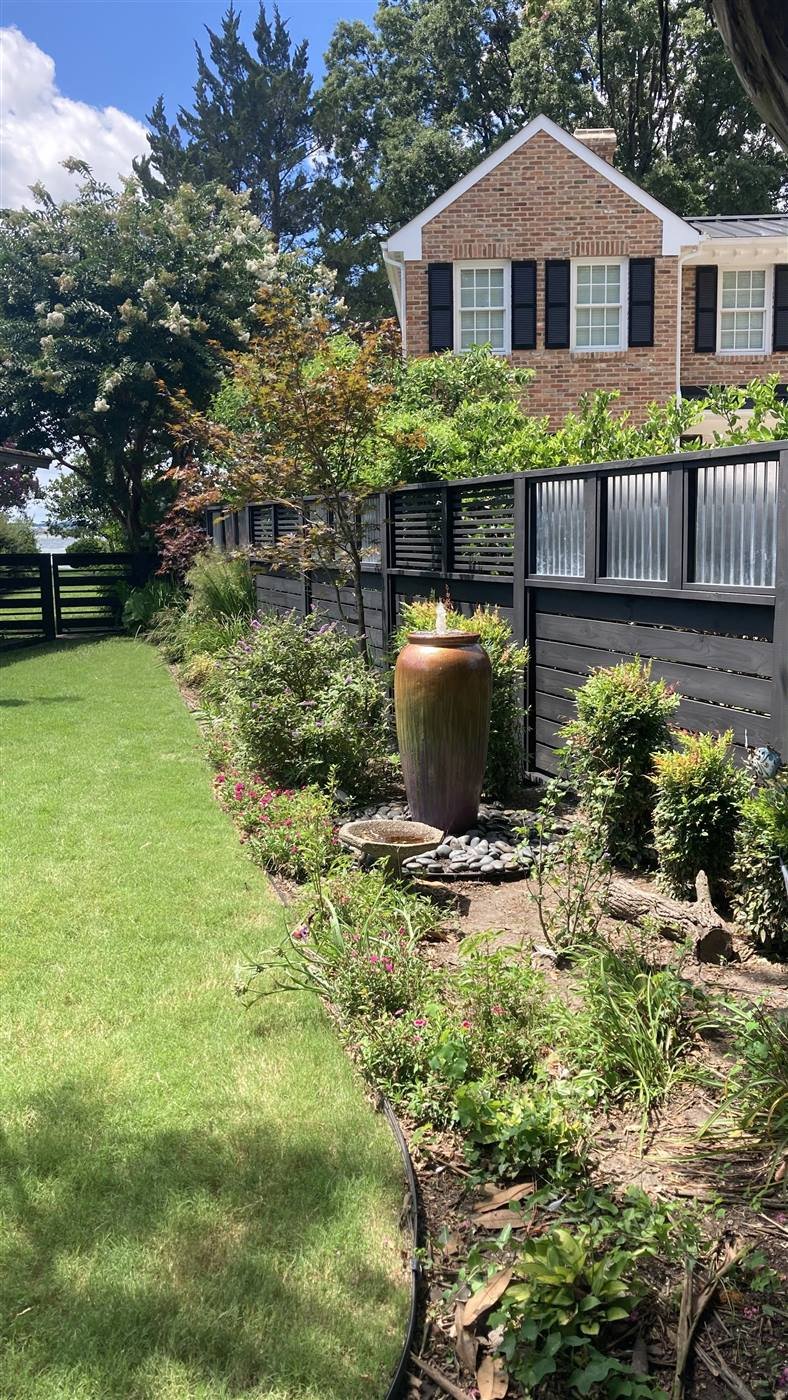
The Riverfront @ Larchmont — alternating wood and corrugated metal panels, Rain Clean finish. See the full project →
Chain-link is the least expensive fence type to install — $8 to $40 per linear foot, with most homeowners paying $10 to $20 and an average total cost of $2,419. It's not built for privacy, but it's fast to install, durable, and needs almost no maintenance beyond tightening the occasional loose tie: a well-kept chain-link fence lasts 15 to 20 years, or up to 30 with a galvanized or powder-coated finish (HomeAdvisor).
Coastal air is the one thing to plan around. Standard galvanized mesh can corrode faster near the fittings and ties in salt air, so vinyl-coated chain-link holds up noticeably better close to the water (Hurricane Fence).
Split-rail is the open, two- or three-rail style most often used to mark a property line or contain livestock rather than provide privacy. It runs $15 to $35 per linear foot depending on material — wood is the traditional choice, but vinyl and composite versions exist that skip the resealing wood requires (Angi; HomeAdvisor). It's a good fit for a large, open lot where blocking the view isn't the goal — marking the boundary is.
Wood costs less upfront and looks more natural. Vinyl costs more upfront but needs almost no maintenance and holds up better against Hampton Roads' humidity and salt air over the long run.
| Factor | Wood | Vinyl |
|---|---|---|
| Cost, per linear ft | $15 – $50 | $20 – $40 |
| Maintenance | Stain / seal every 2–3 yrs | Soap and water only |
| Weather resistance | Vulnerable to rot, warping, splitting | Highly weather-resistant |
| Insect resistance | Vulnerable to termites | Impervious |
| Coastal salt air | Cedar performs best; needs regular resealing and a salt rinse | Doesn't rust or rot; no sealing needed |
Source: Bravo Fence Company, wood vs. vinyl comparison and Hurricane Fence, coastal Virginia materials guide.
Yes, on a wood fence — the end grain at the top of each post is the most vulnerable part of the entire structure. In wet weather, the top of a post absorbs more water than any other part of it, and without a cap that moisture stays trapped, leading to mold, mildew, moss and eventually rot. Sun and wind do the opposite kind of damage: they dry and crack the exposed top, and water works its way into those cracks the next time it rains (Atlanta Post Caps).
A cap sheds that water before it ever soaks in, which is the whole job. It's also a small practical and cosmetic upgrade on top of that: it covers the rough cut edge so nobody catches a splinter running a hand along the fence line, and a pointed or domed style discourages birds and squirrels from perching on the posts. None of that is required to keep a fence standing, but on a wood fence, the water protection is.
"Fence style" and "fence type" aren't quite the same question. Type is the material; style is what you do with it — picket-top versus solid privacy, a plain gate versus one that becomes the focal point of the yard. The material decides your cost and maintenance; the style decides whether the fence just marks a line or actually adds something to the property.
Two more of our own projects show that range. In Colonial Place, Norfolk, a 100-year-old home needed a fence built with full 6x6 posts and southern yellow pine panels — and the homeowner had saved the original garage doors from the house years earlier instead of hauling them off. We built those doors directly into the fence line as a working, functional gate, glass panes and weathered paint intact, with a custom pergola over each entrance. In Greenbrier, Chesapeake, a townhome fence needed to enclose a raised deck and paver patio while tying into the deck railing already installed above it, so we matched the fence's top rail to the same picket-style spindle balusters, built from pressure-treated pine, so the two structures read as one continuous design instead of two projects stacked on top of each other.
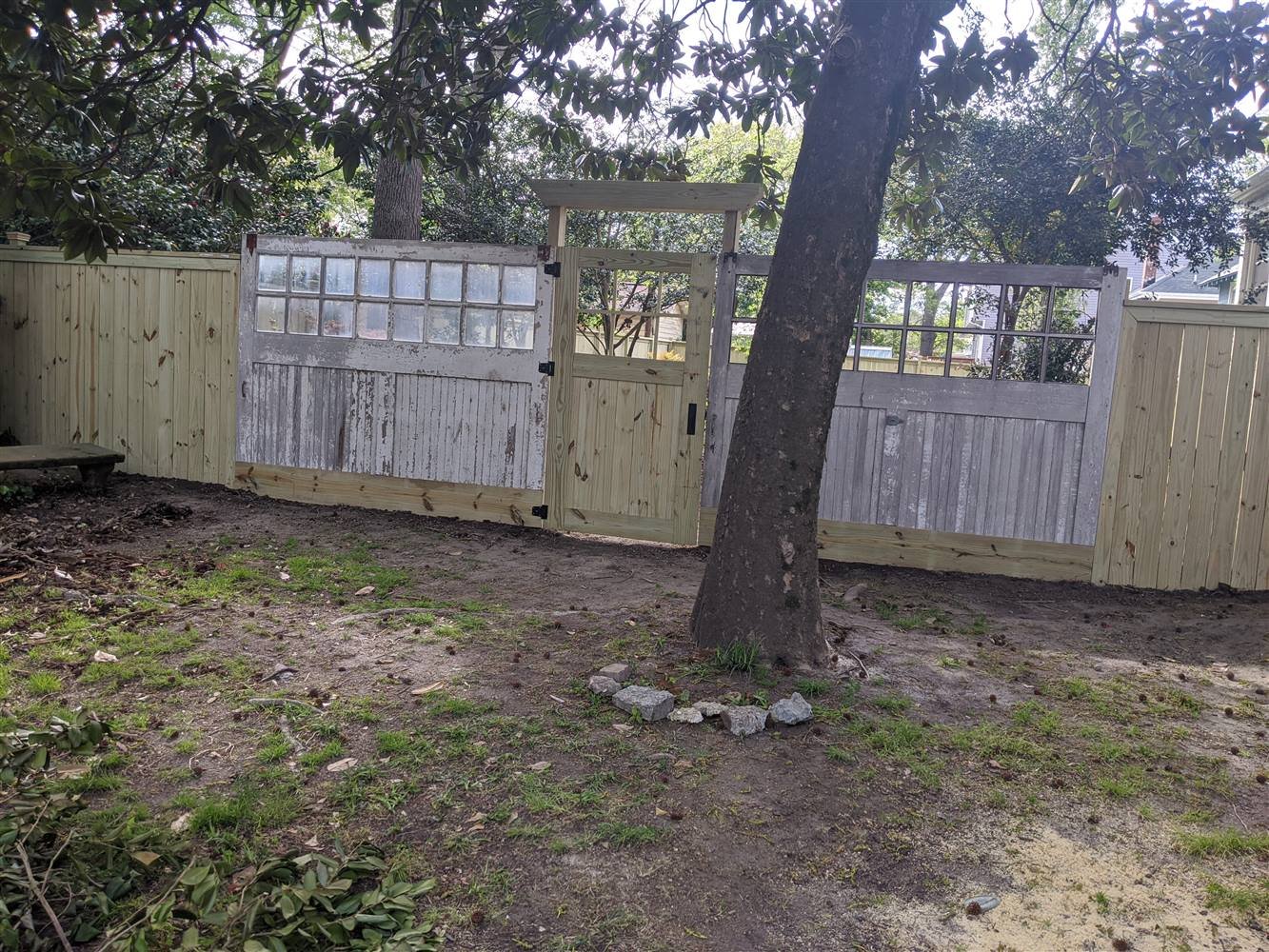
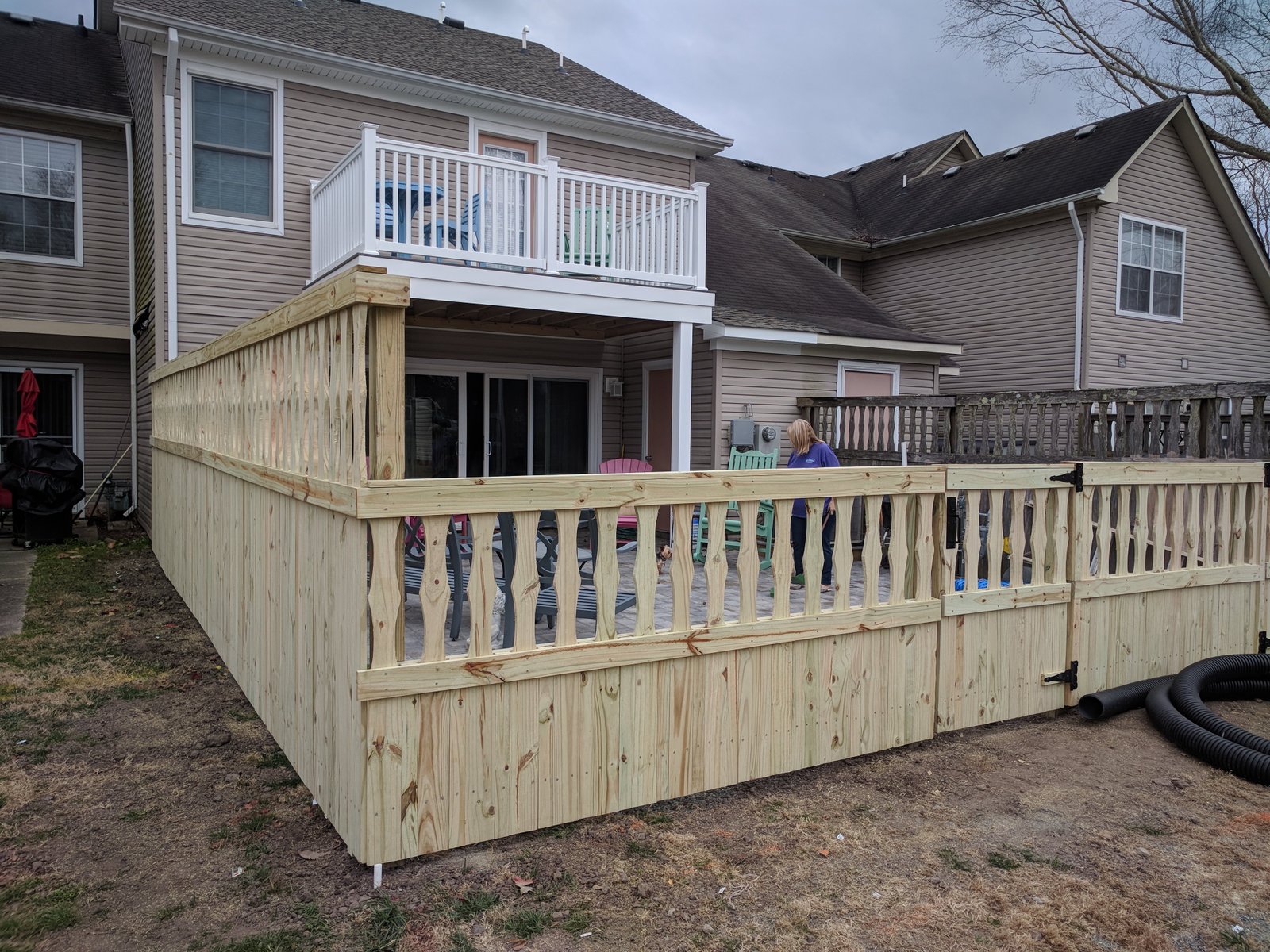
Left: The Garage Door @ Colonial Place — reclaimed garage doors built into the gate. See the full project → · Right: The Picket Deck Fence @ Greenbrier — spindle balusters matched to the deck rail above. See the full project →
Ashleigh designs, Joey builds — on a fence, that split shows up before a single post goes in the ground: how the gate needs to work for the way the family actually moves through the yard, whether the fence has to meet a code requirement like a pool barrier, and what four seasons of coastal humidity are going to do to whatever material gets chosen.
Four real jobs this year show how differently that plays out. The Gallberry Pool Fence in Deep Creek is shadowbox-style pressure-treated wood built around a new pool, sized to Virginia's pool-barrier code first and privacy second. The Riverfront in Larchmont mixes wood and corrugated metal panels with a Rain Clean finish because the yard backs up to the water and needed to look like it was designed, not just installed. Billy's Fence in Greenbrier ties its picket-style top rail to an existing deck railing so two separate structures read as one. And the Garage Door fence in Colonial Place exists because a homeowner saved his house's original garage doors and we found a way to give them a second life as a working gate.
None of those four fences use the same material or solve the same problem, which is really the point of this whole page: "types of fences" isn't one answer, it's five real tradeoffs, and the right one depends on what your yard actually needs it to do. Talk to us about what that looks like for yours.
The five most common residential fence types are wood, vinyl, aluminum (or steel), chain-link and split-rail. Wood is the most versatile and comes in privacy, picket and shadowbox styles; vinyl and aluminum trade a higher upfront cost for near-zero maintenance; chain-link and split-rail cost the least but don't provide privacy.
A shadowbox fence alternates boards on opposite sides of the rail, so each side gets a full board instead of the two sides sharing one flat face. It reads as solid privacy head-on but lets air and a little light through at an angle, and both sides of the fence look identical, which is why it's sometimes called a good-neighbor fence.
Yes, on a wood fence. The end grain at the top of each post is the most water-absorbent part of the whole structure, and without a cap it traps moisture that leads to mold, mildew and eventually rot. A cap sheds that water, covers the rough cut edge, and keeps birds and squirrels from perching along the post line.
Vinyl generally performs better in salt air and humidity — it doesn't rust, rot or need sealing, and it holds up 20 to 30 years with just an occasional wash. Wood, especially cedar, can perform well too, but it needs resealing every 2 to 3 years and a salt rinse to keep up in this climate.
Chain-link is the least expensive option, running $8 to $40 per linear foot with most homeowners paying $10 to $20. Split-rail and pressure-treated wood come in next, both starting around $15 per linear foot, while vinyl and aluminum cost more upfront but less over the life of the fence.
In most Hampton Roads localities, yes, especially for fences over a certain height or ones enclosing a pool. Requirements vary by city, so a licensed contractor should confirm what your specific jurisdiction requires and pull the permit as part of the project rather than leaving it on you.
Written by Ashleigh & Joey, Evoke Design + Build
Husband-and-wife design-build team serving Hampton Roads since 2017. Ashleigh handles design, Joey runs construction. Licensed & insured contractor. Read more about us →
See how we design and build them for coastal Virginia yards, then tell us about yours.