Serving Tidewater · Mon–Fri 9:00 – 5:00
Pergola vs Gazebo · Updated September 2026
The real difference is the roof. A pergola's roof is open and slatted, filtering sunlight but stopping little rain. A gazebo's roof is solid and pitched, blocking both. Pergolas average $4,253 installed; gazebos average $4,708 (HomeAdvisor, 2025). Gazebos suit yards with no shade and heavy entertaining; pergolas suit yards that already have some.
We're a Hampton Roads design-build team that builds both structures, and this comparison shows up in real client feedback we've gotten: "We had a covered pergola built over our patio. It turned out better than I imagined. We are so happy with it!!!!" — Jamie Greene, Google review. The breakdown below is what we actually walk homeowners through on-site.
| Feature | Pergola | Gazebo |
|---|---|---|
| Roof | Open, slatted (beams, rafters, purlins) | Solid, pitched to shed rain |
| Rain protection | Minimal to none | Full |
| Shade | Partial (full if louvered) | Full, all the time |
| Floor | Usually an existing patio, deck or lawn | Often its own raised, finished floor |
| Walls | Open on all sides | Open or enclosed with screens, railings, sometimes walls |
| Best for | Yards with some shade already, framing a space | Yards with no shade, heavy entertaining |
| Avg. installed cost | $4,253 | $4,708 |
| Typical range | $2,118 – $6,433 | $1,580 – $7,866 |
Source: HomeAdvisor, pergola cost data and HomeAdvisor, gazebo cost data (2025). Structural comparison per Bob Vila.
Material tier roughly lines up across both structures, though the underlying products differ (national averages, HomeAdvisor 2025).
| Tier | Pergola (~100 sq. ft.) | Gazebo (total, by material) |
|---|---|---|
| Vinyl | $1,000 – $3,000 | $2,000 – $3,500 |
| Aluminum / Metal | $1,000 – $3,000 | $3,000 – $8,500 |
| Cedar / Wood | $2,500 – $3,500 | $4,000 – $7,000 |
| Redwood / Brick | $4,000 – $5,000 | $4,000 – $7,500 |
Source: HomeAdvisor, pergola cost data and HomeAdvisor, gazebo cost data. Pergola installs run $30–$60 per sq. ft. total (materials + labor); gazebo figures above are total cost by material, not per-square-foot.
A pergola is an outdoor structure with vertical posts holding up an open roof of parallel beams, rafters and purlins — usually wood, aluminum, steel or PVC. There's no solid covering overhead: light, air and rain all pass through. Most pergolas sit on an existing patio, deck or lawn rather than having a floor of their own (Bob Vila).
Some attach directly to the house, using the wall as one side; others stand freestanding anywhere in the yard. We build both, and on our own pergola projects, that choice usually comes down to what the structure needs to connect to — a dining area off the kitchen, a lounge space at the far end of the deck, a walkway that needs framing. Cedar and PVC are the two most common material picks: cedar brings a warmer, natural look that changes with age, while PVC holds its color and shape with next to no maintenance.
A gazebo is a freestanding structure — usually round, hexagonal or octagonal — with a solid, pitched roof that sheds rain and blocks sun completely. It often has a finished floor, slightly raised off the ground, and sides that range from fully open to screened in with mesh, railings or short walls (Bob Vila).
Because a gazebo doesn't lean on an existing wall or roofline the way an attached pergola can, it needs its own complete frame — which is part of why it typically costs more and takes longer to build. In exchange, it's usable in weather a pergola simply isn't: rain, direct sun, even a light snow, depending on how it's enclosed.
A pavilion is the third option people run into while researching this. Like a gazebo, it has a solid roof that blocks sun and rain completely — but it's usually larger, often rectangular instead of round, and built for group entertaining rather than a cozy garden accent (Gazebo.com).
Think of it this way: a pergola is a frame for everyday use, a gazebo is a tucked-away nook, and a pavilion is a roofed entertaining zone sized for a crowd. Pavilions need more open ground to fit and generally cost more than either a pergola or a standard-size gazebo — for most Hampton Roads backyards, the real decision is between the first two.
Yes, but only partial shade. A standard open-lattice pergola filters sunlight the way a tree canopy does — blocking some, letting plenty through, especially when the sun sits directly overhead. For full, adjustable shade, homeowners add a canopy or shade sail, train climbing vines across the top, or upgrade to a louvered pergola roof that closes completely on command (The Luxury Pergola).
Orientation and slat spacing both matter more than most people expect. A pergola built over a spot that already gets some afternoon shade from the house or nearby trees only needs to soften the remaining sun; one built in a wide-open, all-day-sun yard is a better candidate for louvers or a canopy add-on from the start, since standard open slats won't do much at high noon.
Remodeling an aging pergola usually means one of three things: restoring what's there (cleaning, resealing, replacing a rotted post or beam), upgrading it (adding a canopy, shade sail, or converting to louvers), or replacing it outright once repair costs start approaching what a new structure would run. Start with an inspection — soft wood, split beams and rusty hardware are the signs it's time (Pergola Depot).
From there: clean with a soft brush and mild wood detergent (skip the pressure washer, it can chew up the surface), cut out and replace any rotted sections rather than painting over them, and reseal on a schedule — annually or every other year, depending on the wood and the climate. Adding lattice panels or screens to one or two sides is a common mid-life upgrade too, turning a fully open pergola into something more sheltered without going all the way to a full enclosure.
If your yard already has some shade and you want to define a seating or dining area without walling it in, a pergola is the simpler, less expensive choice. If you're working with a wide-open yard, want to entertain rain or shine, and would rather not check the forecast before hosting, a gazebo earns its higher price tag.
Some yards genuinely call for both, worked into the same project instead of picked as an either-or — more on that below.
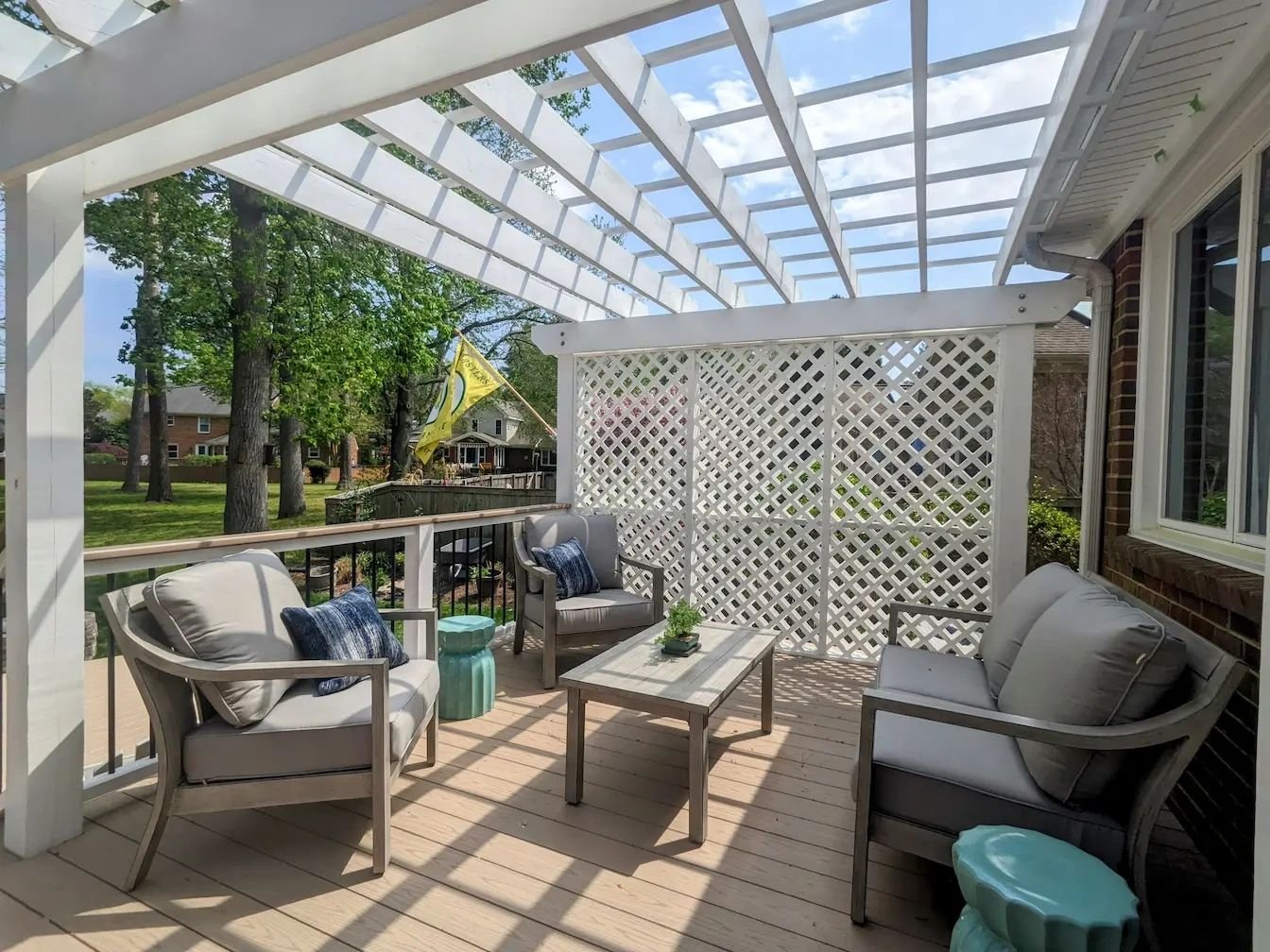
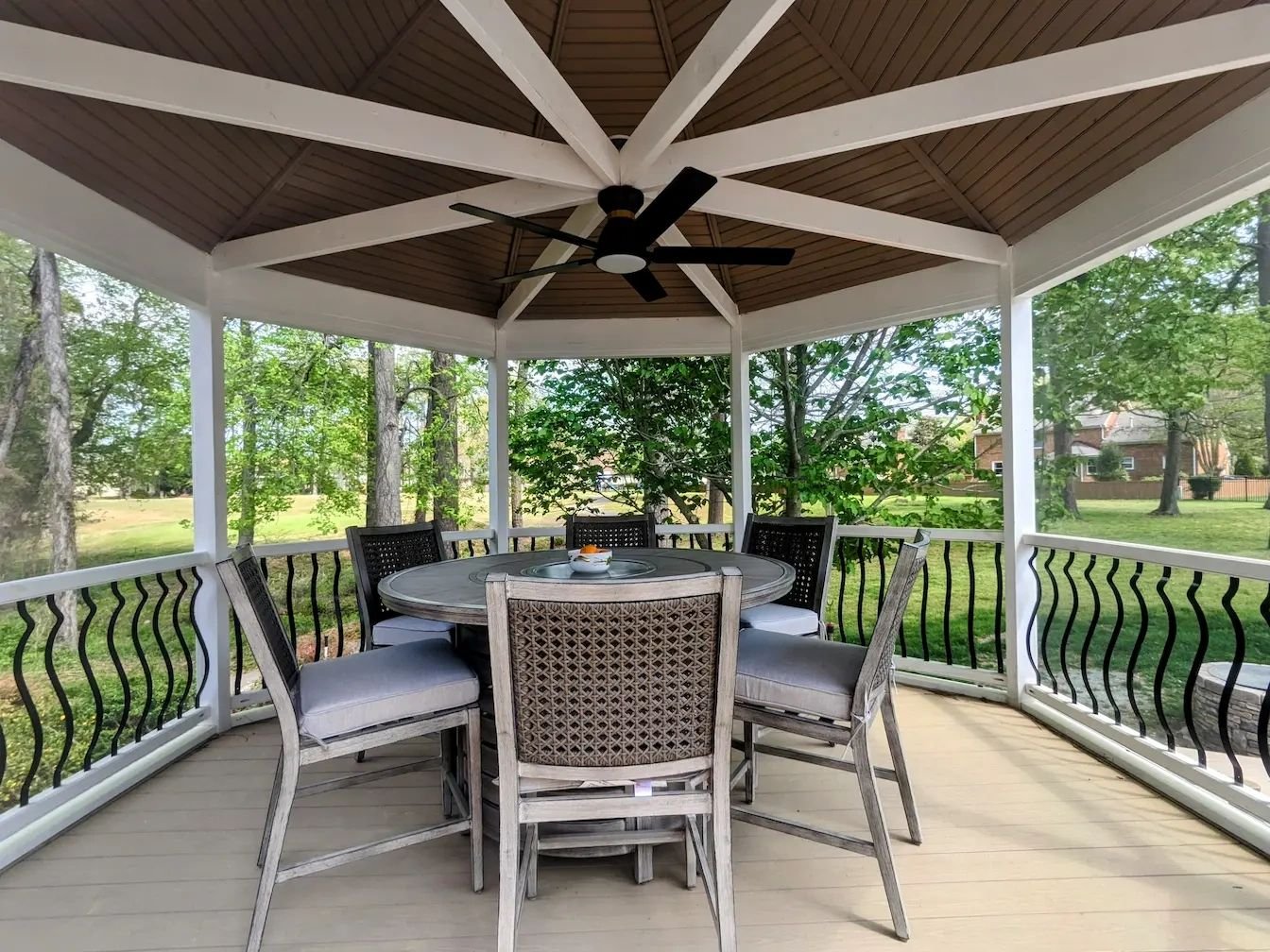
Ashleigh designs, Joey builds — on a pergola or gazebo, that split shows up in the small decisions before a single post goes into the ground: how the structure ties into the house or stands on its own, how post spacing and beam size actually read from the yard rather than just the plans, and what the coastal climate does to the material choice over the years that follow.
Humidity and salt air are part of that material conversation for every outdoor structure we build in Hampton Roads, not just decks. Cedar looks warm right away but needs the most upkeep in this climate — plan on resealing it every year or two. PVC and aluminum cost more upfront and hold their color and shape with next to no maintenance, which is why we point a lot of coastal yards in that direction.
One real example, pictured above: at Cypress Point in Virginia Beach, a backyard called for both structures in the same project — a custom-built gazebo for shaded, all-weather dining, and a pergola over the lounge area a few steps away, both worked into the same deck so neither one reads as an afterthought. See the rest of that project in our gallery, or talk to us about what a pergola would look like in your own yard.
A pergola is an outdoor structure with vertical posts supporting an open roof of parallel beams, rafters and purlins — usually wood, aluminum, steel or PVC. Light, air and rain all pass through the slats. Most pergolas sit on an existing patio, deck or lawn rather than having a floor of their own, and can attach to a house or stand freestanding.
A pavilion has a solid roof, like a gazebo, but is usually larger and often rectangular rather than round or octagonal — built for group entertaining rather than a garden accent. Pergolas cost less and suit tighter spaces; pavilions cost more and need more open ground to fit.
A standard open-lattice pergola provides partial shade, filtering sunlight the way a tree canopy does rather than blocking it outright. For full, on-demand shade, homeowners add a canopy or shade sail, or upgrade to a louvered roof that closes completely.
Start with an inspection for soft or split wood, chipped paint and rusty hardware. Clean with a soft brush and mild detergent, replace any rotted posts or beams, then reseal — annually or every other year depending on the wood and climate. Adding a canopy, shade sail, or converting to louvers are the most common upgrades.
Usually, yes, though the ranges overlap. Pergolas average $4,253 installed nationally; gazebos average $4,708 (HomeAdvisor, 2025). A small vinyl or aluminum pergola can run under $3,000, while a large custom gazebo can run past $15,000.
In most areas, yes, especially for anything attached to the house or over a certain size or height, and requirements vary by locality. A licensed contractor should confirm what your jurisdiction requires and pull the permit as part of the project, not leave it on you.
Written by Ashleigh & Joey, Evoke Design + Build
Husband-and-wife design-build team serving Hampton Roads since 2017. Ashleigh handles design, Joey runs construction. Licensed & insured contractor. Read more about us →
See how we design and build them for coastal Virginia yards, then tell us about yours.